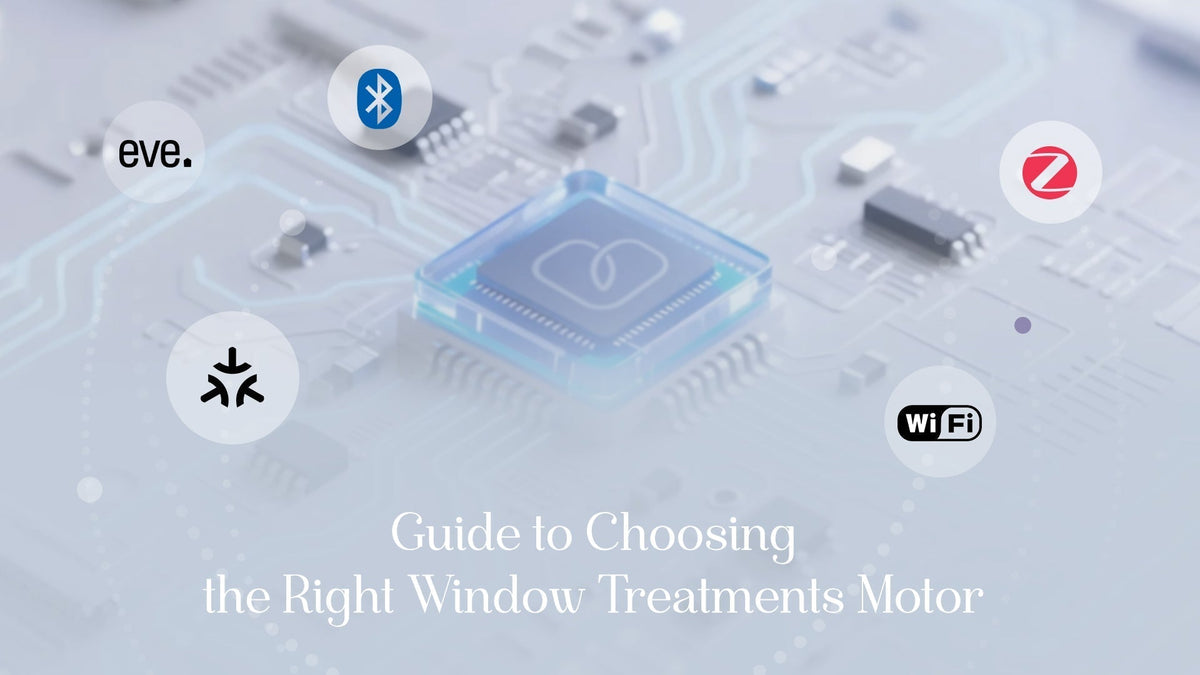
A smart window treatment motor should be chosen by protocol, not by the word smart alone. Bluetooth suits nearby app control with an optional hub. Zigbee is designed for low-power mesh networks and works well in compatible hub-based homes. Hardwired WiFi connects directly to a 2.4 GHz network and uses continuous power. Matter over Thread supports several major smart-home ecosystems but needs compatible Matter and Thread hardware. Eve is primarily suited to Apple Home households. Motor availability varies by shade, so confirm the selected product before ordering.
What Determines How a Smart Motor Works?
A complete system has three parts: the motor that moves the window treatment, the communication protocol that carries commands, and the controller used to operate it. A controller may be a handheld remote, phone app, hub, smart speaker, or home platform.
One motor does not automatically support every control method. The protocol, power source, accessories, and platform must work together. Use the Graywind Smart Control Guide to confirm the exact app, hub, remote, and voice-assistant combination for a selected motor.
Protocol Comparison at a Glance
| Protocol | Hub Required? | Power | Best Ecosystem Fit | Remote Access |
| Bluetooth | No (hub optional for advanced features) | Battery / rechargeable | Any (basic app control) | Only with Graywind Bluetooth Hub |
| Zigbee | No for 7 Alexa devices; yes for others | Battery | Amazon Alexa, SmartThings | Yes (via hub) |
| Hardwired WiFi | No | Continuous (plugged in) | Alexa, Google Home | Yes (always online) |
| Matter (Thread) | Yes — Matter Controller + Thread Border Router | Battery | Alexa, Google, Apple, SmartThings | Yes (via controller) |
| Eve (Thread/HomeKit) | No for basic; HomePod / Apple TV for full features | Battery / rechargeable | Apple HomeKit | Yes (with Apple hub) |
Bluetooth Motor: Hub-Free Entry Point
How it works: Connects directly to your smartphone via the Graywind app within up to 99 ft (30 m). No hub required for basic control.
Best for: Single-room setups, renters, or anyone who wants simple app and remote control without additional hardware.
Limitations: Control is limited to Bluetooth range unless you add a Graywind Bluetooth Hub. Group control, scheduling, routines, and Alexa or Google voice integration all require the hub. Bluetooth connections can have slight response delays compared to WiFi.

Zigbee Motor: Reliable Choice for Alexa Households
How it works: Zigbee creates a low-power mesh network where devices relay signals to each other, extending range and improving reliability. Seven Amazon Echo devices have a built-in Zigbee hub: Echo Plus (2nd Gen), Echo Show (2nd Gen), Echo Studio, Echo (4th Gen), Echo Show 8 (3rd Gen), Echo Show 10 (3rd Gen), and Echo Hub.
Best for: Homes already invested in the Amazon Alexa ecosystem that want a scalable, battery-powered system.
Limitations: Standard Alexa models, Google Home, and Samsung SmartThings require a separate Zigbee Hub (e.g., SmartThings Hub V3). Mesh setup is more involved than a simple Bluetooth pairing.

Hardwired WiFi Motor: Always-On, No Bridge Needed
How it works: Connects directly to your home's 2.4 GHz WiFi network. Must remain plugged into a power outlet at all times.
Best for: Homeowners with outlet access near the window who want the simplest setup and reliable remote access from anywhere.
Limitations: Placement is constrained by outlet location. Adds one more device to your WiFi network, which can matter in congested environments. Not suitable for windows without nearby power access.

Matter Motor: Cross-Ecosystem Compatibility
How it works: Matter is an open-source smart home connectivity standard maintained by the Connectivity Standards Alliance (CSA). Matter motors use Thread for communication — a low-power mesh protocol. To use a Matter motor, your smart home device must function as both a Matter Controller and a Thread Border Router (e.g., Echo 4th Gen, Google Nest Hub 2nd Gen, HomePod mini, Apple TV 4K).
Best for: Tech-savvy users building a multi-vendor smart home who want to avoid ecosystem lock-in.
Limitations: Matter is a newer standard and the device ecosystem is still expanding. Setup requires verifying that your existing hub supports both Matter Controller and Thread Border Router functions — not all smart speakers do. Check your device's spec sheet before purchasing. For more background on Matter's role in smart homes, see our article on Matter: A New Window of Opportunity for Smart Homes.

Eve Motor: Native Apple HomeKit Integration
How it works: The Eve motor uses Thread to connect directly to Apple HomeKit. Basic control works from your iPhone or iPad with no hub. Adding a HomePod or Apple TV (4th Gen or later) as a hub unlocks remote access, automation, and Siri voice control from anywhere.
Best for: Households that use Apple devices as their primary smart home platform and want native HomeKit integration without third-party bridges.
Limitations: Optimized for Apple. Direct integration with Alexa or Google Home is limited. If your household mixes Apple and non-Apple devices, consider the Matter motor instead.

Which Motor Should You Choose?
- No hub, simple setup → Bluetooth (add hub later if needed) or Hardwired WiFi
- Alexa-first home → Zigbee (check if your Echo model has a built-in hub)
- Apple-first home → Eve
- Multi-ecosystem or future-proofing → Matter (verify Thread Border Router support first)
- Always-on reliability, no battery management → Hardwired WiFi
Graywind Motor Compatibility Overview

Once you've identified the right protocol, visit the Graywind Smart Control Guide to see exactly which hubs, apps, and voice assistants are supported for each motor — including step-by-step pairing instructions. Then check the motorized shades collection to confirm your chosen protocol is available on the specific product before ordering. If you're still deciding between treatment types, our comparison of blinds vs curtains vs shades covers which formats support motorization.