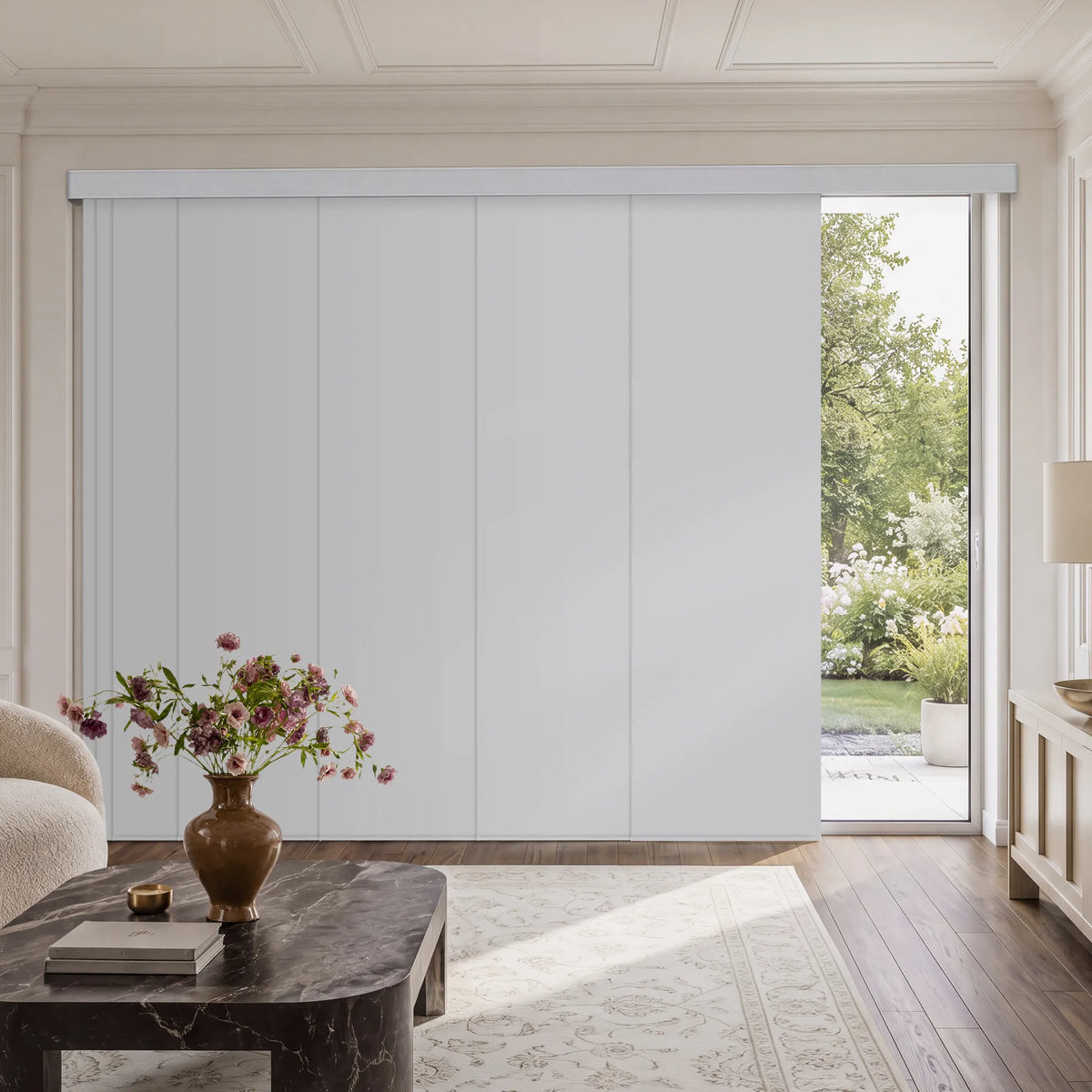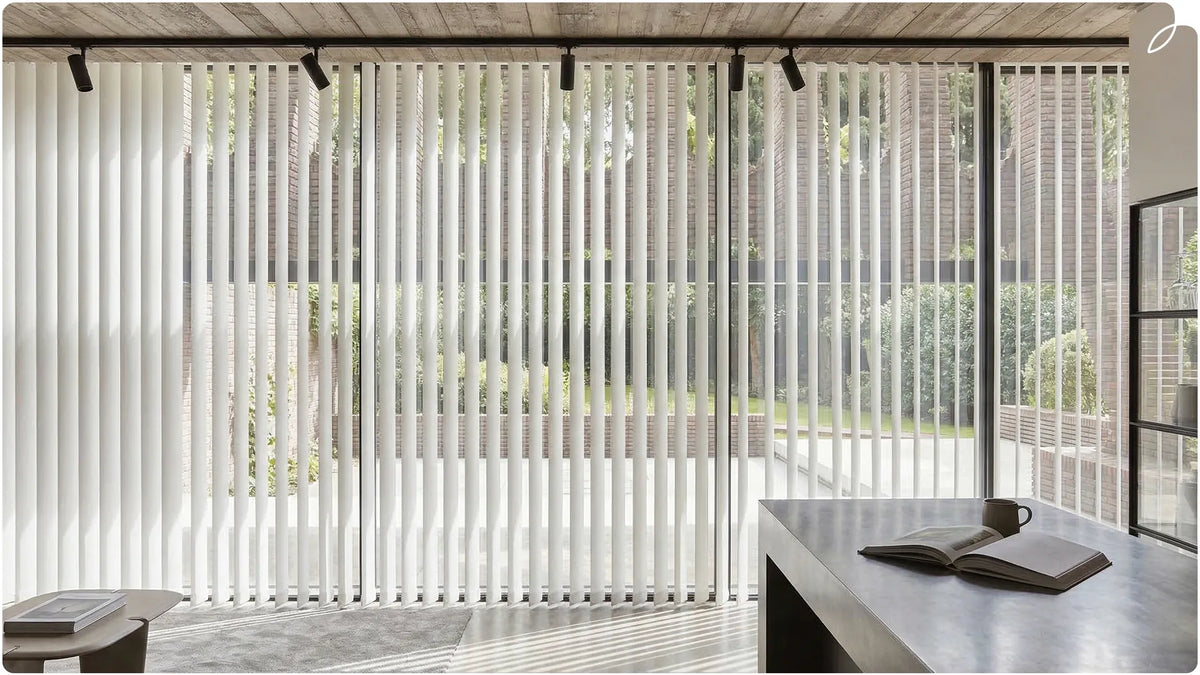
For the strongest privacy, rotate vertical blinds vanes until they overlap and block the main sightline through the window. There is no universal rule that the convex side must face outside during the day and the concave side must face inside at night. Vane profiles, overlap direction, window position, and the viewer's location all affect visibility. During the day, a partial tilt may preserve daylight while limiting the view. At night, fully close the vanes and check the window from outside with the interior lights on.

The Physics of the Vane: Light vs. Sight
Vertical blind control privacy by changing the viewing angle through the gaps between adjacent vanes. Tilting also redirects daylight and glare, but vertical blinds do not function as a one-way mirror.
Some vanes are flat, while others have curved or textured profiles. Terms such as convex and concave therefore do not provide a reliable instruction for every product.
- Light control: A wider opening admits more daylight and preserves more of the outside view.
- Visual privacy: Greater overlap narrows the sightline between the interior and exterior.
The practical rule is simple: judge the gaps and overlap from the position where an outside observer is most likely to stand.
Daytime Privacy: Limiting the Outside View
During daylight, the brighter exterior can make the interior less visible, but this lighting difference does not guarantee privacy.
Recommended Position
Rotate the vanes toward a mostly closed position, leaving only enough angle for the desired daylight. Then check the result from outside at eye level and from both sides of the window.
- Increase the overlap if furniture, screens, or occupants remain visible.
- Reverse the tilt if the open edges point toward the main exterior viewpoint.
- Fully close the vanes when privacy matters more than daylight.
Do not rely on a fixed 30-to-45-degree setting. The effective angle changes with the sun, window orientation, vane width, and observer position.

Nighttime Privacy: Controlling Silhouettes and Gaps
At night, interior lighting makes shapes and movement easier to see from outside. The vane direction does not need a special day-to-night reversal. The priority is complete overlap.
How to Check the Position
- Rotate the vanes until they form a continuous overlapping surface.
- Look for edge gaps, twisted vanes, or sections that do not hang evenly.
- Turn on the interior lights and inspect the window from outside.
Blackout fabric blocks light through the material, but vertical blinds can still have small gaps at vane edges, the headrail, and the floor. They provide stronger room darkening and privacy than light-filtering fabric, but they should not be described as making a room completely invisible.

Special Scenarios
Ground-floor windows: Test the blinds from the sidewalk, driveway, or neighboring property at likely viewing angles.
High-rise windows: Privacy depends on nearby buildings and sightlines, not a specific floor number. Nighttime closure still matters.
Large sliding glass doors: Confirm that the track is level and that every vane hangs straight and overlaps consistently.
Beyond Manual: The Case for Repeatable Control
Manual vertical blinds allow direct adjustment with a wand. Motorized operation is useful when the blinds cover a wide opening, require frequent changes, or are difficult to reach.
Motorization does not change the basic privacy performance of the vanes. It makes repeated opening, closing, and tilting easier. Exact saved angles, schedules, app functions, and voice controls depend on the selected motor and accessories.
The Graywind's Solution
At Graywind, we believe that window treatments should be seen and not "handled." While the physics of vertical blinds remains constant, the effort required to manage them does not.
Our Motorized Vertical Blinds are engineered for those who respect the science of privacy but demand the convenience of modern living.
One-Touch Scene Setting:With the Graywind motorization system (compatible with Alexa, Google Home, and Apple HomeKit), you can program specific angles. Create a "Daytime Privacy" scene that automatically angles the 3.5-inch vanes to the precise convex-out position. Create a 'Evening Privacy' scene that fully closes them into a blackout state. No wand turning.
180-Degree Advantage: Our vanes rotate fully, allowing seamless transition from upward light diffusion to complete downward blackout—precision manual wands can't match.
Absolute Sealing for Night: Rigid motorized track and high-quality blackout fabrics ensure interlocking vanes that eliminate light leaks causing the Shadow Puppet effect.
Designed for the Discerning
We do not believe in "one-size-fits-all." Whether you choose our manual wand control for a guest room or our smart version for your primary living space, the aesthetic remains clean, modern, and elevated. The sleek vertical lines create an illusion of height, making your rooms appear taller while silently managing your exposure to the outside world.

Privacy is not a luxury; it is a requirement for comfort. By understanding the simple physics of convex and concave surfaces, you can reclaim your home from prying eyes. Remember:
- Day: Curved side out for reflection.
- Night: Cupped side in for absorption.
And if you tire of the manual chore required to achieve this perfection, let Graywind handle the angles for you. With smart control, durable construction, and a refined aesthetic, you can finally stop worrying about the window and start enjoying the view—from the inside, where you belong.
Ready to upgrade your sliding doors? Explore Graywind Motorized Vertical Blinds today.
FAq
Do motorized vertical blinds cost much more than manual ones?
Typically yes, but the price gap has narrowed. Motorized systems add convenience, programmability, and integration with smart home routines. Many homeowners find the premium worth it for not having to adjust blinds several times a day.
How do I clean vertical blinds without damaging the slats?
Use a microfiber cloth or a vacuum with a brush attachment. For deeper cleaning, remove the vanes and wipe them gently with mild soap and water. Avoid bending the S-curve shape--once deformed, they won’t seal correctly for nighttime privacy.
Are vertical blinds safe for homes with pets or children?
Yes, with precautions. Avoid loose cords-opt for cordless or motorized designs. Weighted bottom chains help reduce slat movement from pets.